
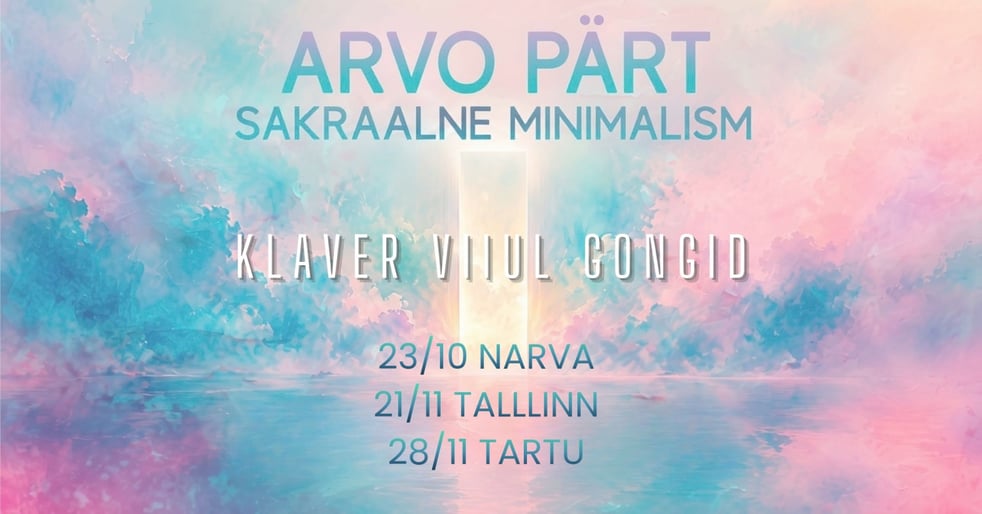
Arvo Pärt. Sakraalne minimalism. Narvas.
Arvo Pärt. Sacral minimalism.
23.10 / 19:00 / Rugodiv, Narva
Meditative concert with music by Arvo Pärt. Chamber music meets sound therapy
Since times unmemorable the music has been a tool to uplift the soul, reach the eternal and illuminate the human consciousness into divine experiences.
Arvo Pärt is well known as one of the authors writing music that goes directly to your soul. Presenting this music with sacral and sacred instruments enhances and deepens the effect.
Arvo Pärt is a composer whose music has often been called „the new simplicity”, also „sacral minimalism” or „new music of the blessed”. He himself classifies himself rather metaphorically:
„Like tintinnabuli” (literally meaning „small bells”, referring to the small church bells that have special sound effects).
„Each phrase is a separate breath. Its inner pain and removing this pain are interconnected and create a breath. During the pauses one should learn to listen to the silence, to know how to feel the vibrations created by each sound, its length and transition into the next sound, the weight of that step. One shouldn’t rush; each step from one point to another on the music sheet must be valued. The step can be taken only after you have let all possible versions of notes to go through your „purgatory”. Only after being through all the sufferings is when the sound can be perfect.”
__________________________
The performance includes following pieces:
• Fratres
• Für Alina
• Spiegel im Spiegel
• Variationen zur Gesundung von Arinuschka
• Ukuaru valss
• Passacaglia
_____________________________
PERFORMING:
LEENA LAAS – Violin.
Violinist Leena Laas has been a member of the Estonian Performers Union since 1999 and has been active works as a soloist and ensemble player. He has given solo concerts in Estonia, Finland, Sweden, Holland, Russia and Germany, and performed a lot of Estonian music in addition to the classical main repertoire at numerous concerts. In collaboration with Nata-Ly Sakkos completed CD "Poème d'amour".
Leena Laasi's passion has been the baroque violin for twenty years. He has graduated from the Academy of Theater and Music for the second time in the Department of Early Music Interpretation, majoring in baroque violin, and is also fluent in the specifics of this instrument.
In addition to active performing activities, Leena Laas is a violin teacher and is instructed master courses in Kokkola (Finland) and Stockholm (Sweden).
Leena Laas works as a violin teacher at Keila and Nõmme Music School.
AULI TEPPO – is one of the most outstanding pianists of the younger generation in Estonia, who gained fame in the first season of the popular television competition "Classical Stars". He has soloed in front of several orchestras, including the ERSO, the EMTA Symphony Orchestra, the Tallinn Chamber Orchestra, the Narva City Symphony Orchestra and the Chamber Orchestra of the Western Islands, and has performed in many parts of the world, including Austria, Italy, Switzerland, Portugal, Poland, Russia and the USA. He is also an active chamber musician and often performs with opera singers. In the collaboration project "Ikoonis/Pärt" between the Tallinn Philharmonic and the Tallinn Dance Theatre, which was last performed in New York, he presented all of Arvo Pärt's piano music.
LILIA MÄRTMAA and DENIS VINOGRADOV – Multi-instrumentalist musicians, Founders of the Healing Sounds Center in Tallinn, sound therapists, master facilitators, popularizers of sound therapy.
___________________________
TICKETS:
Prepaid tickets 22-35 eur, at the day of the concert 28-40 eur
16-23 eur for students and pensioners
Concert duration 1,5-2 h, without break. Door open at 18:30
_______________________________
Address:
A. Puškini tn 8, Narva
INFO:
+372 559 30 551, 5628 5229
info@helid.ee
www.helid.ee
_______________________
Gong:
The gong is essentially an idiophone, producing what is known as natural white noise, accompanied by a wide spectrum of harmonic overtones — subtle, almost inaudible high-frequency sounds that accompany the fundamental tone.
The sound waves generated by the gong interact and flow together, creating new, complex tones that make the sound spatial and unpredictable — so much so that the human mind cannot anticipate it. This is why, during gong meditation, people often report hearing bells, drums, harps, horns, or even human voices or an entire choir — it is our searching consciousness trying to define and interpret the sound it perceives.
This experience is deeply connected to our personal perception of sound. When the gong resonates, so-called combination tones are formed — not in the instrument itself, but within our own auditory system. These combination tones are responsible for the dual perception of sound and are considered by acoustic specialists to be a true phenomenon.
Price information
An additional service fee per ticket may be added to the ticket prices listed in the pricing information. The final ticket price shown at checkout always includes this fee.
Event location
Open in maps app